Building a Real Estate Data Platform on Snowflake with Claude Code
Pakistan's real estate market runs on fragmented data. Listings sit in spreadsheets, broker networks, and portals with little standardization. This creates friction for buyers, agencies, and financial institutions. A Snowflake-backed MCP server offers a way to unify this landscape and expose it through a clean, consistent API that multiple products can rely on.
Structuring Your Real Estate Data
The foundation starts with structuring your data correctly. Keep the model simple and practical. Focus on core entities such as properties, listings, agents, and transactions. Standardize fields like city, society, price in PKR, and size in marla or kanal. This is not just a data exercise. It directly impacts how easily your system can interpret user intent and serve accurate results.
The Semantic Layer: Where Business Value Lives
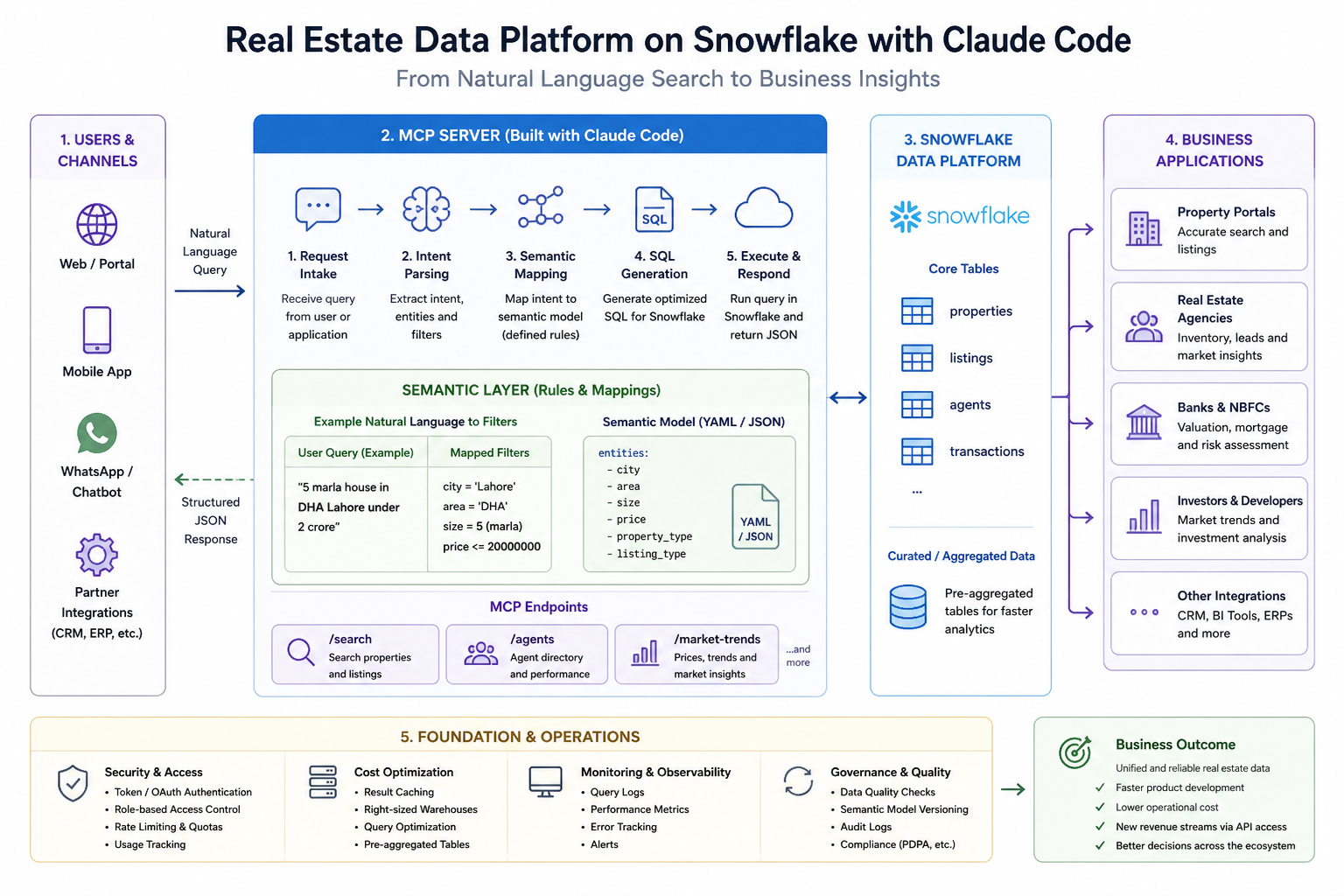
The real leverage comes from the semantic layer. This is where business value is created. Instead of forcing users or downstream systems to understand database schemas, you define how natural language maps to your data. A query like "5 marla house in DHA Lahore under 2 crore" becomes a structured filter on city, area, size, and price. Claude Code can assist in generating and refining this mapping, but the definitions themselves should be treated as a core product asset. This layer determines how effectively your platform understands the market.
Building the MCP Server with Claude Code
With the data and semantics in place, Claude Code can be used to rapidly scaffold the MCP server. The goal is not to build a complex backend, but a thin and efficient translation layer. Endpoints such as search, agents, and market trends should accept simple inputs, apply the semantic model, generate optimized SQL, and return structured JSON. By keeping business logic out of the API layer and inside the semantic definitions, the system remains flexible and easy to evolve.
# Example semantic mapping
semantic_mappings = {
  "marla": {"unit": "marla", "conversion": 1},
  "kanal": {"unit": "kanal", "conversion": 20},
  "DHA": {"city": "Lahore", "area": "DHA"},
  "Islamabad": {"city": "Islamabad"},
  "crore": {"unit": "PKR", "scale": 10000000}
}
User query: "5 marla house in DHA Lahore under 2 crore" # Parsed to SQL: # SELECT * FROM properties # WHERE size = 5 AND unit = 'marla' # AND city = 'Lahore' AND area = 'DHA' # AND price_pkr <= 20000000 ```
Architecture Flow
Complete Platform Overview
The full platform architecture integrates users and channels (web, mobile, chatbot, partner integrations) with the MCP server layer, which processes natural language queries through intent parsing and semantic mapping, then generates optimized SQL for Snowflake. The platform serves multiple business applications including property portals, real estate agencies, banks and NBFCs, and investors, while maintaining security, cost optimization, monitoring, and governance layers at the foundation.
Security and Access Control
Security and access control are essential if you plan to commercialize the platform. Real estate data has clear monetary value, especially for agencies and financial institutions. Implement token-based authentication, enforce rate limits, and track usage per client. This enables you to package your MCP server as a product rather than just an internal tool.
Cost Optimization on Snowflake
Cost management on Snowflake is another important consideration. Real estate queries tend to be repetitive, which makes result caching highly effective. Combined with properly sized warehouses and optimized queries, this can significantly reduce operational expenses. Pre-aggregating common insights such as average prices by area or transaction trends can further improve performance and cost efficiency.
The Experience in Practice
In practice, the experience is straightforward. A user searches for "10 marla house in Islamabad under 3 crore." The request hits the MCP server, the semantic layer translates intent into structured filters, Snowflake executes the query, and the results are returned as clean JSON. This output can power a website, a mobile app, or even conversational interfaces.
From Technical Implementation to Business Platform
What begins as a technical implementation quickly becomes a business platform. Property portals can plug in for standardized listings. Agencies can access cleaner data for sales and inventory management. Banks can use the same system for valuation and mortgage analysis. Instead of selling data in isolation, you offer a unified access layer to the market.
The Long-Term Advantage
Claude Code accelerates development. Snowflake provides scalable infrastructure. The long-term advantage, however, lies in how well you define and maintain the semantic layer. In a market like Pakistan, where data inconsistency is the norm, the ability to standardize meaning is what turns a simple API into a defensible data business.